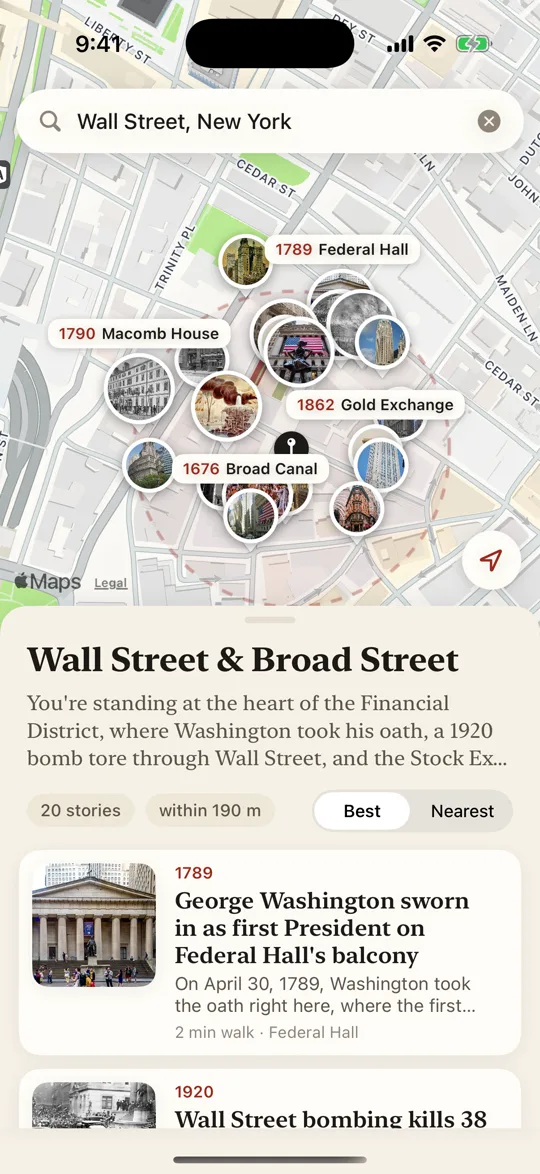
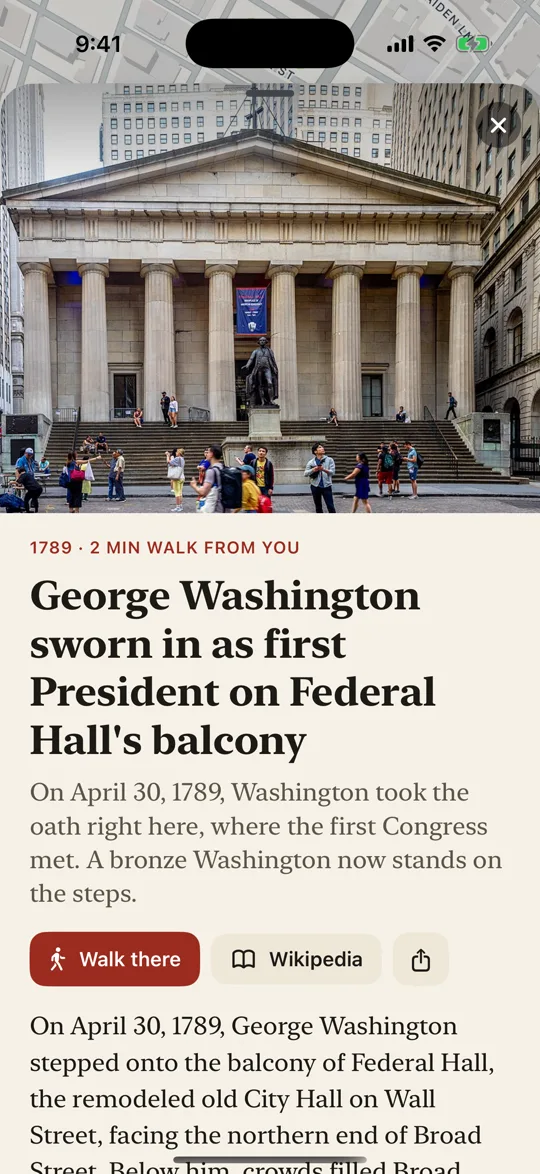
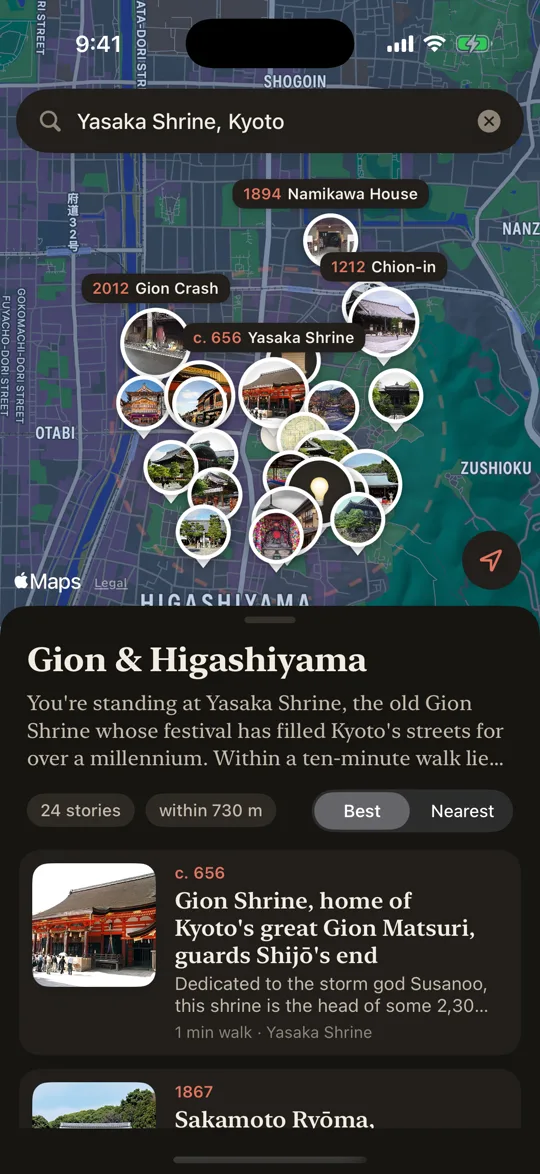
Open History anywhere and see the battles, fires, firsts, crimes, premieres and lost buildings around you on a map, then read the story behind each one.


Every place has its own scale. Downtown Manhattan packs twenty stories into two blocks; the Nevada desert needs fifty miles.
Washington's oath, the 1920 bombing and a filled-in Dutch canal, within 200 m.
Open →Nero's Golden House, gladiator barracks and the arches of emperors.
Open →Punch's debut, Dryden's beating and Europe's first record studio.
Open →A 1,300-year-old shrine, the 47 Rōnin's teahouse and Sakamoto Ryōma's grave.
Open →The Reichstag fire, the Republic proclaimed from a window, and Euler's house.
Open →Place des Vosges, the Prison de La Force and the Rue des Rosiers.
Open →Three days in July 1863, a field at a time.
Open →Pony Express raids and a 1915 earthquake that split the desert.
Open →History looks outward until it has enough to choose from. In a dense city that is a block or two; in open country, several miles.
Encyclopedia articles in English and the local language, Wikidata's dated events and heritage listings, commemorative plaques and historic map features.
Claude reads them all, keeps the ones where something actually happened, and writes the headline, the story, a timeline and what you can see there today.

“Every place you walk past has a story. Most of us never find out what it was.”
History is made to answer that while you're still standing there. Everything it finds is saved by location, so the next person who opens it nearby gets it instantly. There's a native iPhone app, and this web app works in any browser.